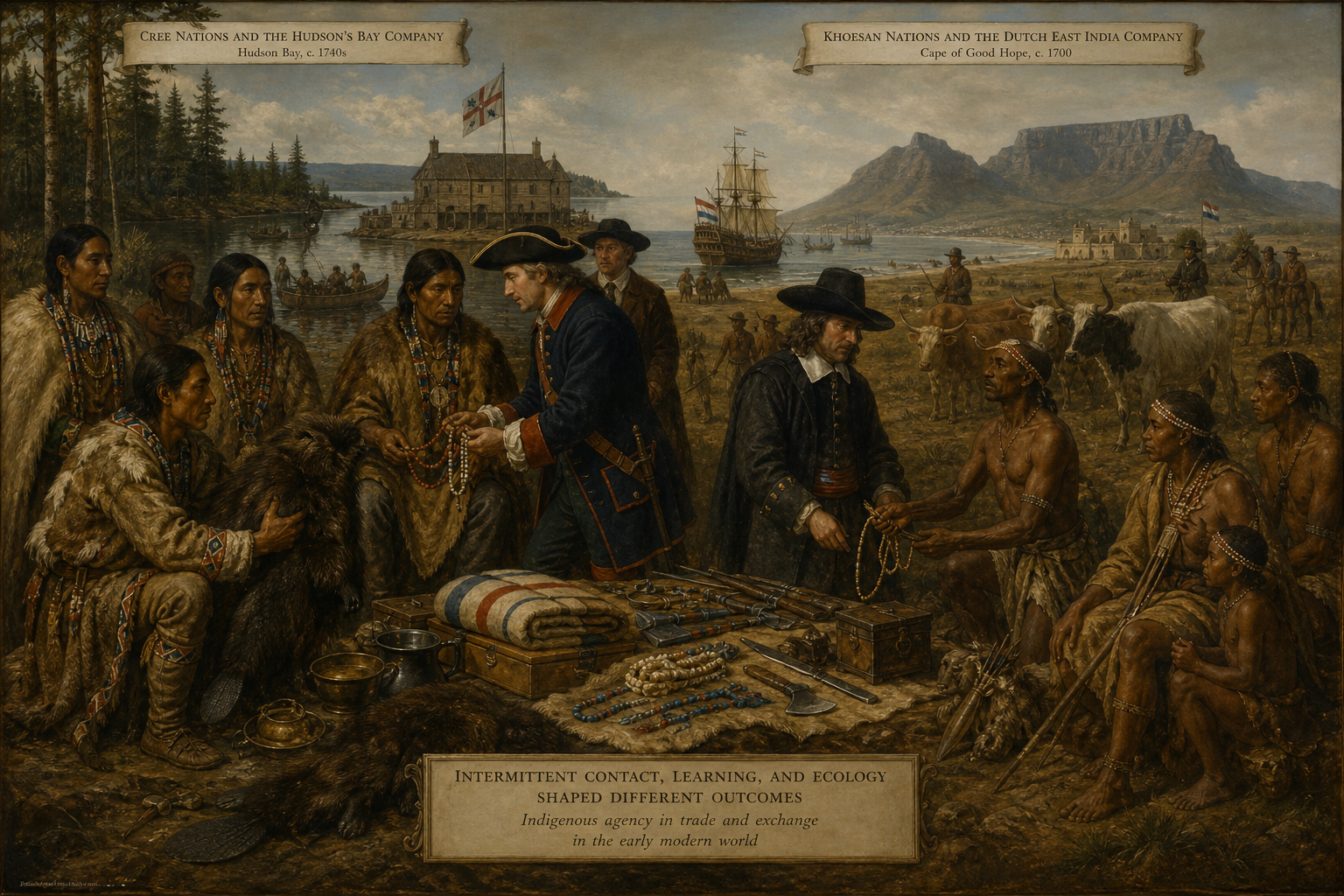
The story of early modern globalization is usually told from the perspective of European expansion. Trading companies like the Dutch East India Company (VOC) and the English Hudson’s Bay Company (HBC) are cast as the protagonists – arriving on distant shores, establishing posts, and integrating new territories into emerging global markets. Indigenous peoples, when they appear at all, are relegated to the margins: passive victims of dispossession, or at best, junior partners in someone else’s enterprise.
This framing is not just incomplete. It is fundamentally wrong. In our recent article in the Economic History Review, we argue that Indigenous communities at both the Cape of Good Hope and Hudson Bay were active architects of the very trade systems that connected these regions to world markets. The Khoe pastoralists of southern Africa and the Cree peoples of subarctic Canada set the terms of trade, controlled access to essential commodities, and shaped the ecological landscapes that European commerce depended on.
Why Compare the Cape and Hudson Bay?
At first glance, the VOC at the Cape (1652) and the HBC at Hudson Bay (1670) seem to have little in common: a Mediterranean-climate provisioning station trading in cattle, and a subarctic fur trade supplying European hat markets. Yet beneath these differences lies a striking structural parallel. Both companies arrived in regions whose Indigenous inhabitants possessed deep environmental knowledge, controlled access to the commodities Europeans wanted, and had well-established systems of exchange.
Indigenous Peoples as Price-Setters, Not Price-Takers
One of the most persistent myths in the history of colonial trade is that Europeans simply dictated terms to Indigenous peoples, exchanging trinkets for valuable commodities. The evidence tells a very different story.
At Hudson Bay, the Cree demonstrated sophisticated market behaviour. They understood the comparative value of their furs and negotiated accordingly. When the HBC offered terms they found unfavourable, Cree traders redirected their trade to French competitors operating inland. The HBC’s own records reveal the Company repeatedly adjusting its “standards of trade” in response to Cree bargaining pressure.
At the Cape, the Khoe similarly controlled the cattle trade upon which the VOC’s refreshment station depended. The Company needed a reliable supply of livestock, yet the Khoe were under no obligation to sell and often demanded higher prices or refused to trade. Khoe leaders strategically managed their herds, deciding when and where to engage with Dutch buyers.
Ecology Was Not Just a Backdrop – It Was a Tool
Our paper introduces ecological knowledge as a critical dimension of Indigenous agency. Both the Cree and the Khoe possessed generations of accumulated environmental expertise that Europeans lacked.
The Cree managed the boreal forest through deliberate burning practices that shaped animal habitats and maintained beaver populations. Their knowledge of seasonal migration patterns and waterways was indispensable. At the Cape, the Khoe’s management of the fynbos landscape through controlled burning was equally consequential. These were actively managed environments, not untouched wildernesses.
Underestimating Indigenous Agency
Much of the economic history of colonialism has been written within frameworks that assume European primacy. When we examine the actual mechanics of trade—who controlled supply, who set prices, and who could walk away—the picture is one of genuine negotiation between parties with real, if asymmetric, power. This matters far beyond the seventeenth and eighteenth centuries. A fuller account of how the modern world was made must place Indigenous actors at the centre of the story. The economic history of colonialism is not a story of European agency alone. It never was.
References
Carlos, A. M., Green, E., Links, C., and Redish, A., ‘Early modern globalization and the extent of indigenous agency: Trade, commodities and ecology’, Economic History Review, 78 (2025), pp. 721–748.
Feature image generated with AI.